 Rock
Rock Currently, I’m a Senior Developer at Nylon, where I led the ISO 42001 certification end to end, the AI management system, the policy and risk work, the governance embedded in the engineering lifecycle, and the measurement system for LLM reliability underneath it, the test data, the benchmarks, and the harness that keeps answering the question as the models change.
Three decades designing the systems other engineers build on, and still writing the code.
ISO 42001 certification led.
30 years in technology.
Teams of up to ten.
Two companies co-founded.
-
26–Present
Senior Developer
Nylon
Led the ISO 42001 certification programme end to end, the AI management standard, scoping and standing up the management system, driving the policy, risk and impact assessment work, and embedding governance into the engineering lifecycle through to audit readiness. Alongside it, a whitepaper benchmarking language model performance across the product’s real workloads, a reusable evaluation harness in Node.js, and an architecture review of the document processing pipeline with optimisations to ingestion and retrieval.
Bottom Line → Reliability you can put a number on, and the governance record an auditor will accept, on a reusable harness, so the numbers still hold every time a model or a prompt changes.
-
20–26
Chief Scientific Officer & Co-Founder
SimSage UK
Set the technical strategy for an enterprise AI search company and consulted on search solutions with a Fortune 1000 US company and enterprise clients across the UK, while owning the architecture and delivery of the engine itself, data model, service decomposition, Kafka event pipeline and deployment topology, alongside the security protocols, the RBAC model and the ISO 27001 work governing sensitive data across every connector and tenant.
Bottom Line → 250k+ lines, 30+ enterprise API connectors across SharePoint, OneDrive and Google Drive, production AI workflows on Gemini, OpenAI and Copilot, and a team of three carried through the full SDLC.
-
18–19
Senior Developer
MBIE / NZ Immigration (Contract)
C# .NET and SQL development on Azure inside Linux environments, the design of the unstructured data integration and NLP processing behind the department’s signal analysis in a government risk context, and consulting on NLP methods for record processing across the agency.
Bottom Line → 170 million text records processed, with machine learning applied to the data quality problem underneath them.
-
16–18
NLP Specialist
Booktrack.com
Advised the CTO on development strategy and the company’s machine learning and NLP direction, while researching and building the neural networks for emotional text analysis, context understanding and speech-to-text at the centre of its IP.
Bottom Line → Core development in C#, SQL, Java and Python, deployed on Kubernetes and Docker across Google Cloud and Azure.
-
15–16
Developer / DevOps (Contract)
Verifone
Ran CI/CD and DevOps operations, and took ownership of the complex technical issues that made it as far as level-three support, on systems where every defect is somebody’s actual money.
-
08–15
Chief Scientist & Co-Founder
SYL Search
Consulted with NZ Government departments on their search implementations, and defined the technical roadmap and designed the semantic search engine they adopted, MOT, NZTA and MPI among them, including the complex integrations with SharePoint, CRM and social platforms behind it.
Bottom Line → A team of five led through the full SDLC and the IP creation, mentored throughout.
-
04–08
Senior Architect, Microsoft Team
Datacom
Solution architecture for Datacom’s enterprise customers as part of the internal Architecture Solution Group, pre-sales technical assistance and technical writing, competing for and winning large projects with teams of up to ten engineers, and acting as team lead and mentor.
-
95–04
Where it started
-
02–04Video Games Developer Takapuna, C++ on Xbox titles
-
98–02Developer Datacom Auckland, Visual Basic
-
97–98Developer Terabyte Interactive, led the America’s Cup Virtual Spectator team
-
96Network System Administrator University of Auckland, Windows NT, support for ~20,000 students
-
95–96Developer UoA Language Laboratories, C and HyperCard
-
↓
Built, and still running.
A home lab and what has been built in it, a Prolog engine with an MCP server bolted to its side, three games, and a library that takes text out of a PDF for good.
PI & piview
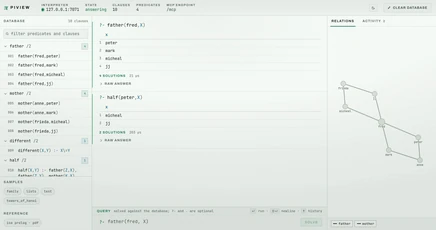
A Prolog interpreter written to be read as much as used, hand-written recursive-descent parser, a flat node stack, an indexed name/arity database, and no third-party dependencies at all. piview gives it two more faces: a live web view and an MCP server. A clause typed at the prompt, one asserted by an agent, and the listing in the browser are all the same database, changing under each other in real time.
pdf-redaction
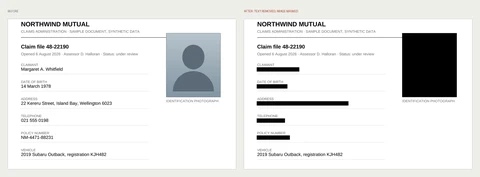
A redaction engine that actually redacts. The common tools draw a black rectangle over the text and ship a PDF whose content stream still contains every word underneath, copy, paste, and there it is. This one intercepts the text operators themselves, strips the characters while holding the visual layout together, and re-encodes any raster image overlapping a redaction zone with the pixels blacked out.
G-Force X
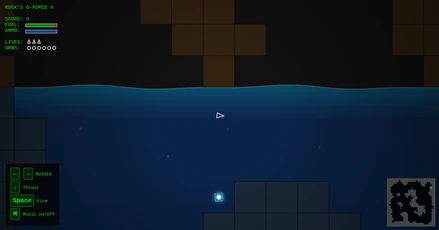
A momentum-based cave navigator, and the most physical thing here. Thrust adds to velocity the way it does in Asteroids, and the cavern has two media, air pulls you down, water floats you up and thickens the drag, so the same input means two different things depending on where the ship is. The terrain is cellular automata, flood-filled so every pocket connects: if you can see it, you can fly to it.
Super Asteroids
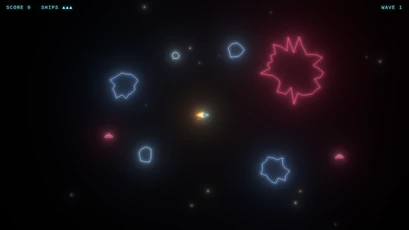
Asteroids with the edges taken off. The ship is pinned to the centre of the view and the universe is translated around it, so there is no screen to wrap at, rocks spawn into a ring outside the viewport and are collected again further out, which keeps the field infinite while the live entity count stays flat. Vector line under a bloom pass, and every laser is pitched off the last so a firefight does not turn into one flat tone.
Space Invaders
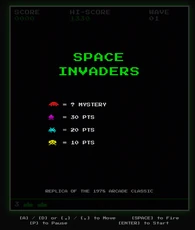
The 1978 cabinet, rebuilt in a canvas element with no framework and no build step, because the classic is a near-perfect specification, and the details are the whole game. Eleven columns by five rows, one shot on screen at a time, bunkers that erode block by block as they take fire, and a step interval scaled to the number still alive: nine tenths of a second with the formation full, a twentieth of a second with one left.
Missile Command
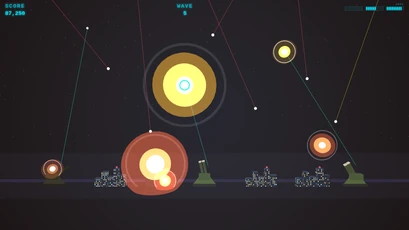
The 1980 cabinet under neon, in three.js. Three batteries, ten interceptors to a wave, and a sky where the first shot matters more than the rest: anything caught in a blast is destroyed, and each of those kills detonates in turn, so a well-placed interceptor chains across the screen while a hurried one clears a single warhead. The waves answer back, warheads that split into independent tracks at altitude from the second, smart bombs that steer around your explosions from the third.
This & That.
Black belt in Wing Tsun Kung Fu, and a composer of orchestral music, the scores are open source and the recordings are on YouTube.
Democratic, social and highly collaborative as a lead, I take responsibility for my team’s mistakes, mentor closely, and consistently prioritise the result over anyone’s ego, mine included.
Credentials
- MSc, Computer Science, University of Auckland Focus on natural language processing, grammar, language semantics and knowledge representation.
- BSc (Hons), Computer Science, University of Auckland Awarded the Senior Prize in Computer Science.
- Machine Learning certification, Stanford University, via Coursera Artificial intelligence and deep-learning neural networks, 2013.
Languages
English Dutch German French